
Reconcile the cash change
Start with income, opening balances, and closing balances. The monthly cash-flow map shows how the figures should connect.

Turn a month of transactions into a clear plan: see the spending, find recurring leaks, protect the essentials, and make the next dollar more useful.
Your entries stay in this browser. No bank login required.
You can learn where money goes without giving every service access to a bank account or full statement. The right method depends on the detail you need and the information you are comfortable sharing.
WHERE.YOU takes a manual, private-by-design approach. Start with reconciled totals, keep uncertain transactions visible, and move to more detailed records only when they answer a real question.
| Method | Useful when | Trade-off |
|---|---|---|
| Enter category totals | You want a quick monthly map and already know the totals. | Private and fast, but only as complete as the figures entered. |
| Connect an account | You want automatic transaction imports and ongoing tracking. | Less manual work, but it requires sharing account data with a provider. |
| Upload a statement | You need transaction-level classification without a live bank connection. | Detailed, but the file may contain names, account details, and merchant history. |
A useful spending total must match the change in your cash. Reconcile first, remove internal money movement, classify what remains, and only then decide what to change.
Start with income, opening balances, and closing balances. The monthly cash-flow map shows how the figures should connect.
A transfer is not new spending. Neither is a card payment when the card purchases are already included. Use the transfer and card-payment check.
Separate obligations, flexible spending, periodic costs, and unresolved items. Our decision-focused category method keeps uncertainty visible.
Compare the cleaned month with real priorities and upcoming bills. Then build a budget from actual spending, not an idealized month.
Suppose your exports show $6,500 of debits. That is not automatically $6,500 of spending. A $700 move to savings and a $900 card payment duplicate money already represented elsewhere. External spending is $4,900. Against $4,500 of income, cash should fall by $400.
| Statement line | Amount | Treatment |
|---|---|---|
| Exported debits | $6,500 | Starting total, not the answer |
| Transfer to your own savings | -$700 | Exclude from spending |
| Card payment covering imported purchases | -$900 | Exclude the duplicate |
| External spending | $4,900 | Compare with income and balances |
| Income less external spending | -$400 | Should match the cash change |
Method reviewed 23 October 2026 by the WHERE.YOU Editorial Desk. The example is illustrative and does not represent a household benchmark.
Each tool produces an explanation, not just a number.
Build a category map and compare needs, wants, savings, and unresolved cash.
Open toolAnnualize recurring charges and flag the candidates worth checking.
Open toolStress-test the plan and see where the next available dollar can go.
Open toolCompare net projected value after APY, fees, and your own deposits.
Open toolA four-part learning path from raw transactions to stronger cash reserves.

A useful spending analysis is an accounting exercise before it is a budgeting exercise. Start with complete transaction data, normalize merchants, separate transfers, and only then compare categories.
Read the hub
Recurring does not automatically mean wasteful. The objective is to identify commitments, surface renewal risk, and evaluate each charge in context.
Read the hub
A budget is a forward-looking allocation, not a verdict on last month. Good plans fund essentials, true expenses, safeguards, and flexible spending in that order.
Read the hub
The best account depends on the job of the money. Emergency cash needs reliable access; planned spending may tolerate notice periods or balance conditions.
Read the hubOne guide from each topic path changes daily. Every permanent guide receives a direct homepage path during the 10-day cycle.
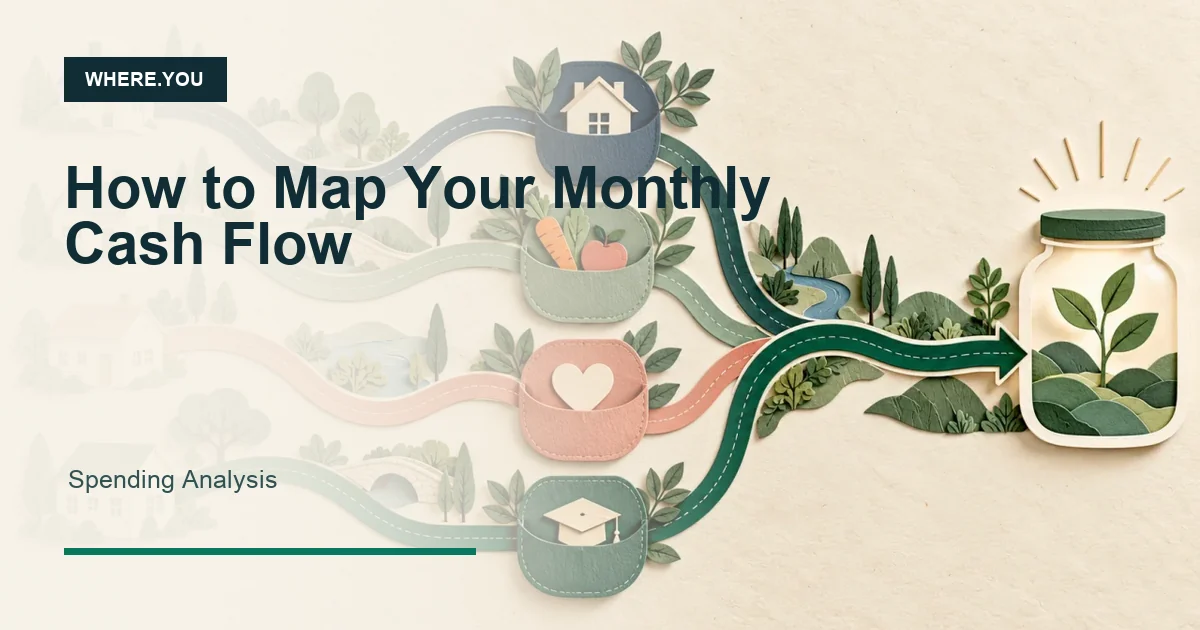
A transaction-by-transaction method for reconciling income, spending, transfers, refunds, and the change in your cash balance.
Detect recurring charges across monthly and annual billing cycles, then separate subscriptions from essential recurring bills.

Use reconciled spending, true expenses, minimum obligations, and explicit trade-offs to create a budget that can survive the month.
Compare savings accounts using APY, fees, balance rules, access, deposit insurance, rate tiers, and projected net value.
Visible assumptions, worked examples, clear limits, and an action you can take without handing over personal data.
Read our editorial policy