
The test for a useful category
Use the fewest categories that change a decision, document their boundaries, and keep uncertainty visible.
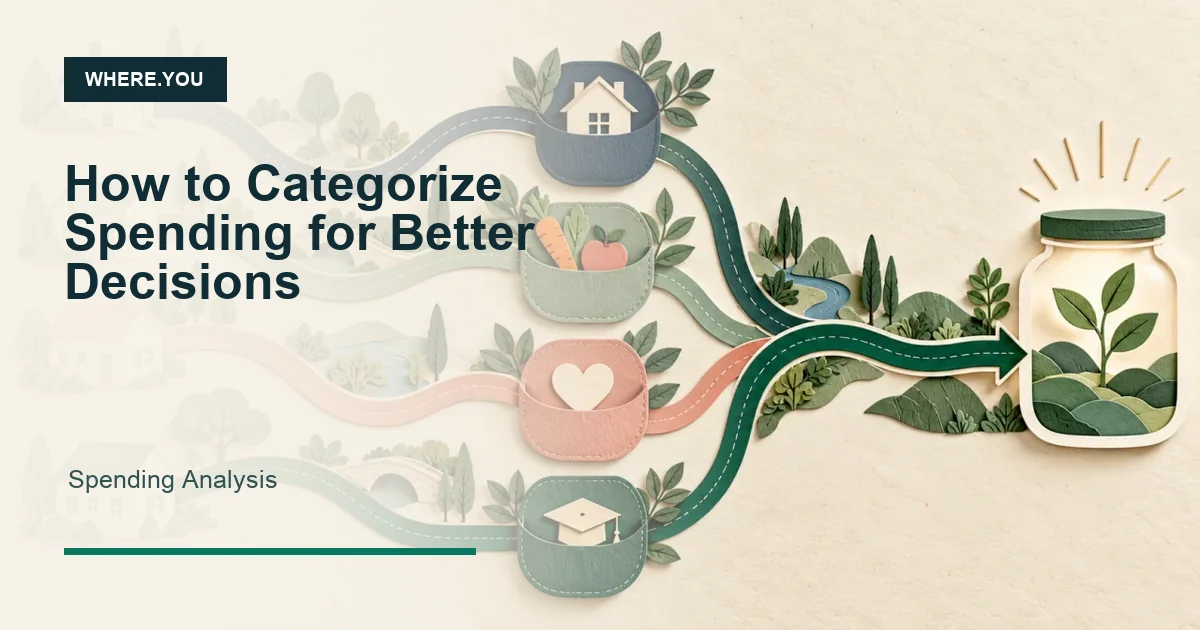
A useful category system is neither a single “miscellaneous” bucket nor a hundred merchant-level labels. It is a compact set of definitions that leads to an action.
Decision-ready categories at a glance
A spending category is useful when a change in its total leads to a different action. Merchant labels alone do not provide that decision boundary.
Questions the decision must answer
- Two people can apply the written boundary consistently
- The total is large or important enough to review
- Mixed and reimbursed purchases have a stated treatment
Decision when categories overlap
Merge categories that lead to the same action. Split a purchase only when evidence and the size of the difference justify the extra work.
Begin with the decision
If the question is whether housing costs can change, separate rent, utilities, repairs, and household goods. If the question is food planning, separate groceries from meals prepared outside the home. Do not create a category merely because software offers it.
Write a one-line rule for every category
| Category | Boundary rule | Common edge case |
|---|---|---|
| Groceries | Food and routine household consumables bought for home use | A supermarket receipt containing clothing |
| Transport | Costs required to move people, excluding travel holidays | Fuel bought during a road trip |
| Dining | Prepared food purchased for immediate consumption | Work meal later reimbursed |
Split only when evidence improves the decision
A $160 warehouse-store receipt may include groceries, medicine, and a small appliance. Split it when the receipt is available and the amounts are meaningful. Otherwise place it under the dominant purpose and add a note. False precision is not better data.
Handle reimbursements consistently
Record the original purchase in its true category and treat the reimbursement as an offset to that category. Calling reimbursement income overstates both income and spending.
Run a category usefulness test
- Would a change in this total cause a different action?
- Can two people apply the rule consistently?
- Is the category large enough to review?
- Does it overlap another category?
- Can unresolved items stay separate until evidence appears?
Test a category with a real decision
Suppose dining rose by $120. A useful category lets you distinguish a planned family event from a repeated convenience pattern. If both lead to different actions, add a note or subcategory. If they lead to the same decision, extra detail may create maintenance without insight.
Use a category dictionary with four fields: the category name, what belongs inside, what is explicitly excluded, and how mixed purchases are handled. This makes month-to-month comparisons more reliable when another person reviews the file or when the same merchant sells several types of goods.
Resolve edge cases consistently
| Edge case | Recommended treatment | Reason |
|---|---|---|
| Reimbursed work meal | Record the meal, then offset the same category when reimbursed | Avoids overstating income and spending |
| Mixed warehouse receipt | Split material items when evidence exists; otherwise use dominant purpose and a note | Prevents invented precision |
| Gift card purchase | Choose purchase-time or redemption-time treatment and use it consistently | Avoids counting both events |
| Cash withdrawal | Leave unallocated until supported by a log or receipt | The withdrawal does not prove the final use |
Retire categories that stay tiny, overlap another definition, or never change a decision. A shorter stable system is stronger than a detailed system that is applied inconsistently.
Turn categories into decisions
If inconsistent merchant labels are splitting one spending pattern, clean that layer with Fixed, Variable, and Periodic Expenses Explained.
Once category rules are stable, compare equal periods and explain the largest changes with Build a Budget From Your Real Spending.
Measure how the decision-ready categories affect the monthly picture in the category-based spending calculator.